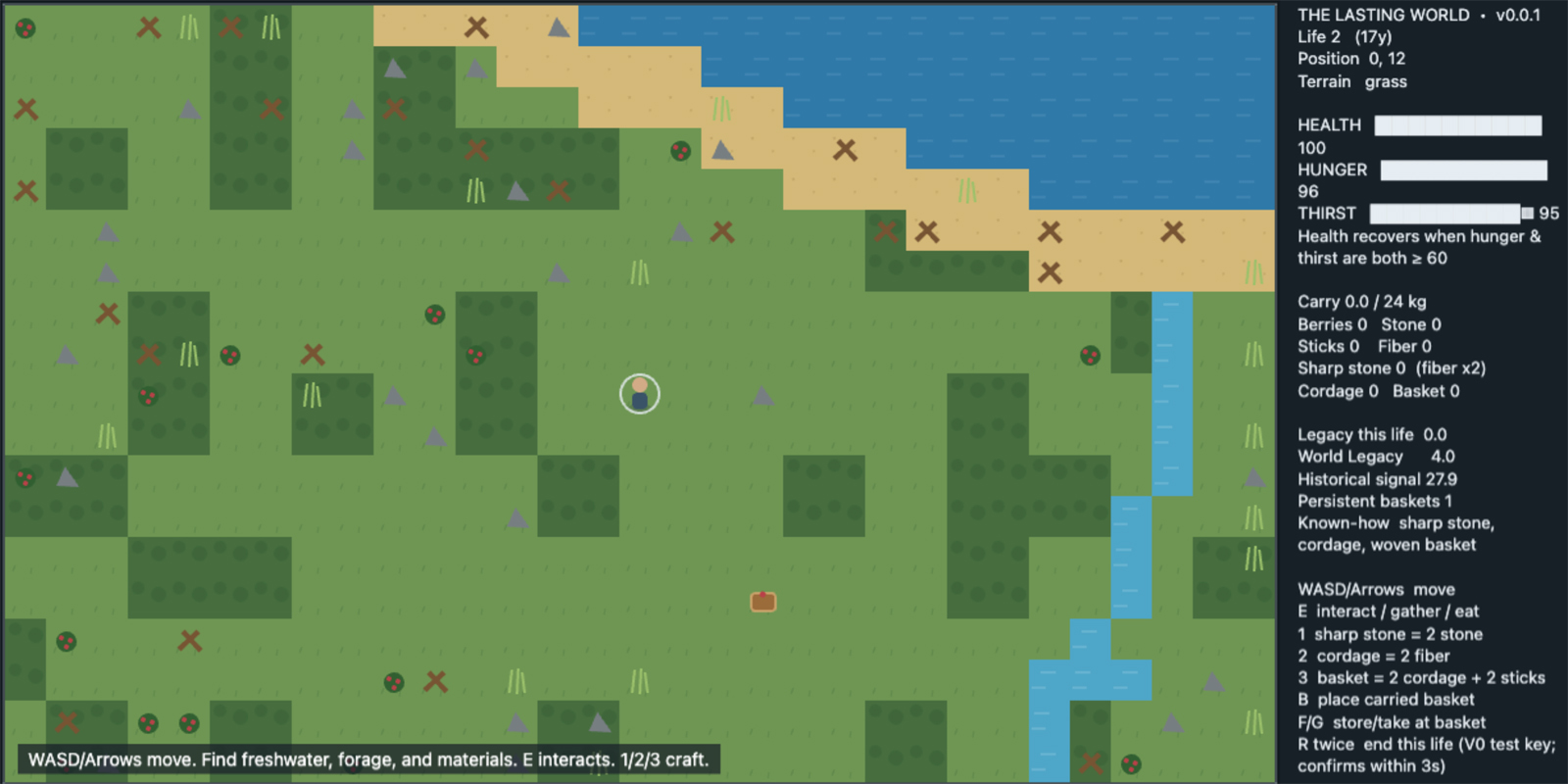
Is the world procedurally generated?
Yes. Terrain and resources are generated from a world seed instead of being laid out as one fixed hand-built map. The systems are still early, so we describe it as procedural and open-ended rather than promising a literally infinite world.
Does the world keep its history?
That is one of the central rules of the project. The current browser build already preserves some world state between lives. The larger architecture is being built so meaningful objects, discoveries, places, and player-caused changes can survive software updates and individual characters.
Is it multiplayer?
Not yet. The current playable build saves locally in your browser. The project is moving toward one shared persistent world, but the website will not call that multiplayer until different people are actually participating in the same canonical world.
What does the AI actually do?
The developer AI can choose and implement small game improvements inside protected rules and technical limits. Automated tests and validation run before a change can become a public playable build. Human work on infrastructure, security, and integrity is kept separate in the public history.
Can I watch the AI work?
Yes, within safe boundaries. The Live Development page can show the current feature, stage, model, activity summaries, builds, and public commits. Private chain-of-thought, credentials, private prompts, and unrestricted logs are deliberately not published.
Who controls the AI?
Humans do. Humans can stop autonomous development, set model and cost limits, protect credentials, review high-risk actions, repair infrastructure, and change the project's Constitution. The AI is a developer inside a controlled system, not the owner of the system.
Is this supposed to become a finished game?
There is no fixed finish line. The aim is for the game to keep becoming more interesting, coherent, and worth returning to while preserving its history. Development can pause, change pace, or end someday, but the project is designed around continued evolution rather than a single final update.
Why make the development history public?
Because the development process is part of the experiment. You should be able to see what the AI changed, what humans changed, when a build became playable, and how a very small world grew over time.